“Why Sell at Auction? Because There’s No Better Way”
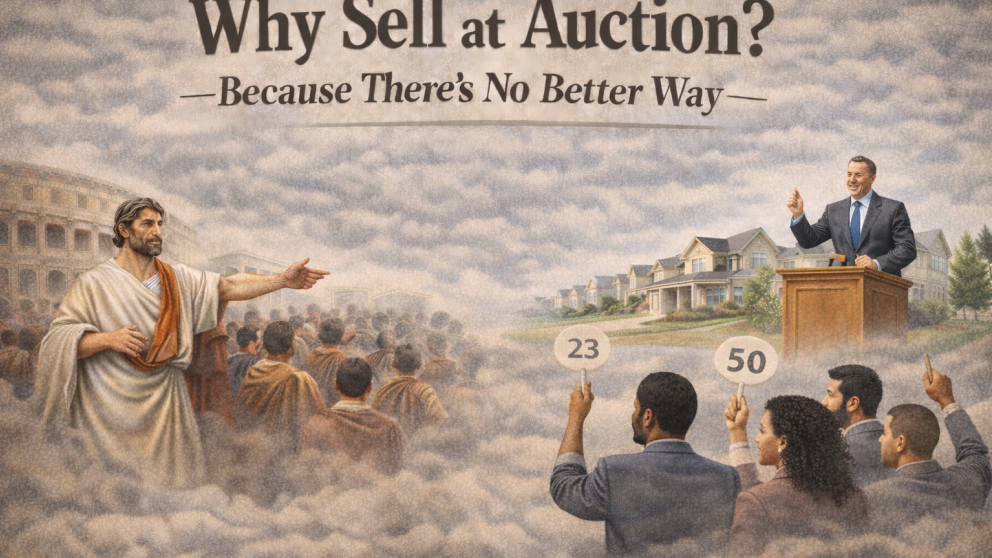
Why Sell at Auction? Because There’s No Better Way
Reflections of a Second-Generation Auctioneer
Hello Reader,
As I write this article, I sit here hoping it might open a few minds—a thing that tends to happen once people really start to understand the world of auctions. Then I stopped and thought about it: why would someone even read this? Maybe they Googled or asked ChatGPT, “What’s the best way to sell my house or business?” Probably not. The “traditional routes” usually rank higher. But that gave me an idea—let’s start with why auctions are actually the real traditional method.
As I dug into research for this piece, I came across things I had never seen before. Naturally most of my knowledge comes from my dad, Tim Dudley, who’s been in the business longer than almost anything else in his life—besides his marriage, my twin sisters being alive, and the Minnesota Vikings’ Still not having a Superbowl (Skol Vikes). My expertise comes from hearing and absorbing the trial and error he went through starting as a 25-year-old with two young kids and no backup plan. I wasn’t there at the beginning, but being around the business long enough to see the patterns form taught me how auctions really work.
To stay on topic, though, I realized something fascinating: human history itself has always revolved around selling, trading, and valuing things. Since the earliest tools and farming, people have bartered and bid. There’s an old joke about the world’s oldest profession—I’ll let you look that one up so no one gets offended—but if you sit in a room full of auctioneers, someone will always chime in: “And the second-oldest was an auctioneer.”
It’s not totally accurate—but it’s not wrong either. Auctions are one of humanity’s oldest professions, dating back thousands of years. Greek historians wrote about women being sold to wed the highest bidder (not a great start, admittedly), Romans sold the spoils of war, and in 7th-century China, monks’ belongings were auctioned after death.
Jump to the 1980s, and the U.S. Treasury was auctioning billions in Treasury bills and notes every week through sealed bids—followed by the Department of the Interior auctioning off mineral rights, which it still does today. And say what you will about government efficiency, but if even the federal government trusts auctions as the safest, most transparent way to sell something, maybe they’re onto something.
The truth is, auctions have touched everything—land, art, weapons, castles, computers, and even empires. In fact, in 193 AD, the entire Roman Empire was auctioned off by the Praetorian Guard. It didn’t go great—it sold for about $8.25 per guard in today’s money and sparked a civil war—but it shows that when something has value, people turn to competition to find the right price.
Over time, auctions evolved. By the 15th to 18th centuries, candlelit sales were held in European coffeehouses. Then came Sotheby’s (1744) and Christie’s (1766), which established catalogues that revolutionized transparency and visibility. Ireland and Australia built their real estate systems on auctions, where every agent is an auctioneer.
And then came the Internet—suddenly you could sell a house in Indiana to a buyer in Argentina without leaving your chair. Auctions went global, and the business became less about talking fast and more about connecting people fast.
But every time auctions push the world forward, they also take the blame when the world’s falling apart. During the 2008 financial crisis and the Great Depression, banks and foreclosure departments leaned on auctions because, frankly, it was the only system strong enough to handle chaos. That didn’t make the method bad—it made it necessary.
Yet, as always, it left a “bad taste,” and people started thinking of auctioneers as the folks who “sell junk.” One headline even called an auction company “where restaurants go to die.”
But that’s not the real story.
Why Auctions Actually Work (The Psychology Part Nobody Explains)
Here’s the part most people miss: auctions don’t just work because they’re fast—they work because they are built around how people really behave. Selling by private negotiation tries to force humans to be rational. Selling by auction expects them to be competitive.
At an auction, three things happen at once:
- Visibility – everyone sees others want the same thing.
- Scarcity – there’s only one winning bid.
- Momentum – once bidding starts, it’s emotionally harder to stop than to keep going.
That’s the magic. When someone becomes the “winning bidder,” they instantly start viewing the item as theirs. Every new bid feels like a threat of loss, and humans hate losing more than spending a little extra to win. It’s called loss aversion, and auctions harness it better than anything else in economics.
They also provide real-time social proof. When ten people are competing, the market itself is saying, “This is worth it.” That transparency is exactly what buyers crave.
So why do auctions work?
- People bid because other people bid.
- They stay in because they’ve already imagined owning it.
- They stretch because they don’t want to lose in public.
- Sellers win because competition forces honesty.
In short, auctions aren’t a discount method—they’re a value-revealing method.
What Auctions Give Sellers That No Other Method Does
Let’s talk about the seller side. A properly marketed auction gives you what no private sale can:
- A set date. You know when your market will speak.
- A competitive environment. You’re not begging one buyer to like it.
- Public price discovery. The market tells you what it’s worth, live.
- Less stress and faster closure. Time is no longer your enemy.
- Control. The seller sets the terms, not the buyer.
That’s why I fight the “distressed property” stigma. Distress didn’t invent auctions—efficiency did.
If your property is unique, hard to comp, or in a shifting market, the auction isn’t risky—the listing is. A listing exposes you to months of carrying costs and uncertainty. An auction exposes you to demand.
And let’s be honest: most deals die in private sales because people get bored, second-guess, or overthink. Auctions cut through all that. Time kills deals; auctions weaponize it.
“But Don’t Auctions Leave Money on the Table?”
That’s the oldest myth in the book.
People say, “What if the right buyer isn’t there that day?”
My question back: “What if the right buyer never shows up at all?”
With the right marketing, an auction doesn’t lose value—it pulls the market to a single moment and forces it to compete. The only time an auction fails is when it’s treated like a yard sale: no marketing, no education, no financing options, no storytelling.
The problem isn’t the method—it’s the execution.
The Future of Auctions (and Why We’re Not Going Back)
We’re living in the golden age of auctioneering.
- The internet erased geography.
- Online bidding erased intimidation.
- Data erased guesswork.
Now, we can see exactly who looked, clicked, registered, and bid. I can sell a property in Indiana to someone living in Argentina while sitting in a hotel in Jamaica—and both sides know exactly what’s happening.
The next phase is what I call the “blended auction.” (its actually called a Simulcast Auction, but I like being complicated, I guess) Part online, part live. A marketing campaign that builds momentum for weeks and climaxes in a single, transparent, high-energy moment.
And here’s the truth: the more transparent the world becomes, the more auctions make sense. People don’t trust backroom deals—they trust public competition.
So… Why Sell at Auction?
Because from ancient Greece to the U.S. Treasury, people have always faced the same challenge:
- We have something valuable.
- We need to sell it fairly.
- We need to know we got the right number.
- And we don’t have six months to wait.
Every time, the answer was the same: bring everyone together and let them compete.
Auctions aren’t some niche technique—they’re humanity’s original marketplace. Everything else—listings, appraisals, negotiations—is just an imitation of what a good auction does in one afternoon.
So if you’re a seller, a banker, an attorney, or even another agent with a tough listing, take it from a second-generation auctioneer who watched his dad build a business from nothing:
There’s no better way than an auction. Start treating it like a Plan A.







__footer.png?v=1628087212)