What a Foreclosure Sale Is Worth When Somebody Actually Markets It
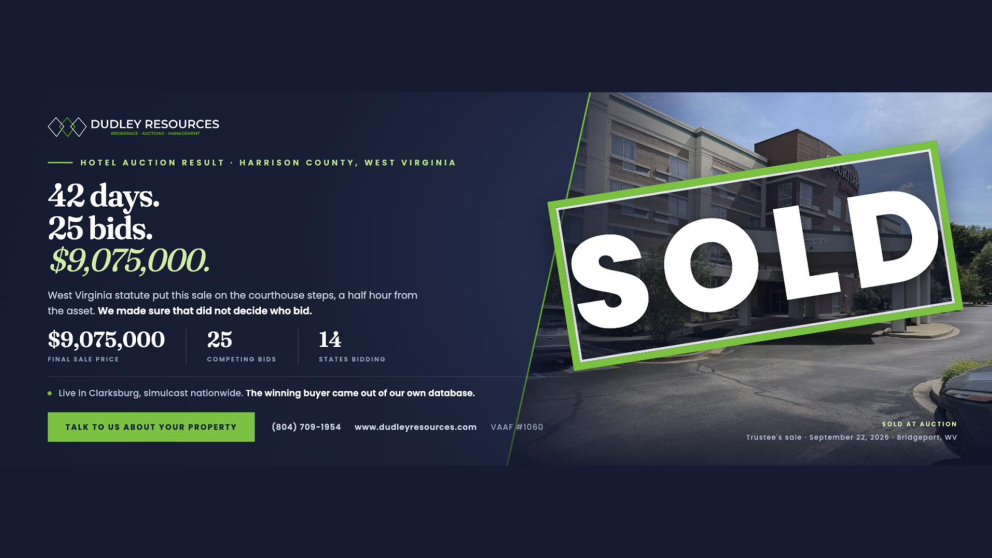
What happened in Clarksburg on September 22
At two o'clock on a Tuesday afternoon, a trustee's sale opened on the steps of the Harrison County Courthouse in Clarksburg, West Virginia. It was pouring rain.
Twenty-five bids later, it closed at $9,075,000.
The property was a 102-room Courtyard by Marriott in Bridgeport, about a half hour from the courthouse. That matters less than you would think. What matters is that almost everything about this sale was set up to go small, and it didn't.
Why most foreclosure sales go small
Start with the statute. West Virginia allows a lender holding a deed of trust to foreclose without going to court, through a sale conducted by a trustee. The law puts that sale at the courthouse in the county seat. Not at the property, and not in a conference room down the road from it. The date and the time come from the notice of sale, and the notice runs in the legal section of the local paper, which is about the last place a commercial buyer looks.
Then the day itself. A weekday afternoon, outdoors, and when it came, a downpour. If you set out to design a sale that only the people already standing nearby would attend, you would end up with something very close to this one.
Most foreclosure sales run exactly that way, and the outcome is predictable. A handful of people on the steps, most of them lawyers. One or two local operators who happened to catch the notice. Often the only serious bid comes from the lender, credit bidding to take the asset back. The statute is satisfied, the sale is valid, and the number gets written down as what the market paid.
It isn't what the market paid. It is what the six people who showed up paid.
None of that is anyone's fault. A trustee's job is to conduct a lawful sale, and a legal notice is a compliance document. It was never designed to sell a hotel. The gap between a lawful sale and a well-attended one is where most of the value in a foreclosure is won or lost.
What the statute controls, and what it leaves open
The statute decides where the sale happens, when it happens, how the notice is published, and what the notice has to say. That is the whole list.
It says nothing about how many qualified buyers know the sale exists. It says nothing about whether those buyers have seen the operating numbers, whether they have their financing lined up, or whether they can bid without getting on a plane. Those are all open, and they are the variables that set the price.
So for 42 days, that was the whole job.
How the sale was marketed
The legal notice ran because it had to. Next to it we ran a paid campaign on LinkedIn, Google and Meta and put the property in front of commercial buyers on Crexi, LoopNet and MyState MLS. The listing page drew 7,790 sessions before sale day. The traffic was never the point. It told us who was paying attention.
The people most likely to buy a hotel are not browsing for one, so we went to them. A thousand postcards went to Courtyard owners across the country, to regional hotel operators, and to the bankers and bankruptcy attorneys who see these assets before anyone else does. The names at the top of those lists got a phone call from us.
How buyers were qualified before sale day
Anyone who wanted the operating numbers signed an NDA first. That gave us something more useful than a traffic count. By sale day, 35 buyers from 14 states had put their names on paper, from Oregon and Nevada across to Massachusetts and New Jersey. We knew who was serious before anyone stood in the rain.
Qualification also meant being plain about the terms. This sale required a $250,000 deposit, $100,000 on the day of the sale and the remaining $150,000 within three business days, with a 10% buyer's premium and closing in 30 days. Terms like that filter out spectators. A buyer who has read them and is still on the phone with you is a buyer who intends to bid.
How the courthouse location stopped mattering
The statute fixed the venue, so we made the venue matter less. The sale ran live on the courthouse steps and simulcast online, with one of our staff relaying the online bids to the auctioneer as they came in. A buyer on the other side of the country could compete on the same footing as one who drove over from the next county, and never had to get wet doing it.
That is the difference between a hybrid sale and an in-person one. The legal sale still happens exactly where the law says it must. The bidding room is simply bigger than the steps.
What the result was
Twenty-five bids. A final price of $9,075,000, set by buyers competing against each other rather than by whoever braved the weather.
The buyer who won was already in our database before we ever took the assignment. The campaign didn't find him. It gave us a reason to call him, and it put real competition in front of him once he decided to bid.
What lenders, trustees and attorneys can take from this
An auction is not a distressed sale. It is a value discovery system, and it returns exactly what the number of qualified bidders inside it justifies. Two bidders produce a two-bidder price. Twenty-five produce something else.
That holds for any foreclosure, not just a hotel. The statute, the courthouse, the calendar and the weather were all out of our hands in Clarksburg. How many of the right buyers knew this sale was happening was not. That part is a choice, and it is made by whoever the lender, the trustee or the attorney hires to run the sale.
If you are a lender deciding how to dispose of a foreclosed asset, the question worth asking before the notice runs is not only whether the sale will be valid. It is how many qualified buyers will be bidding when it opens.
How to find and bid at a foreclosure sale: frequently asked questions
What is a foreclosure sale?
A foreclosure sale is the public sale of a property after the borrower defaults on a loan secured by it. The lender, or a trustee acting under the loan documents, sells the property at auction to recover the debt. Depending on the state, the sale is run either through the courts or by a trustee outside of court.
What is the difference between a trustee's sale and a sheriff's sale?
A trustee's sale happens in a non-judicial foreclosure, where a deed of trust lets a trustee sell the property without a lawsuit. A sheriff's sale, or commissioner's sale, happens in a judicial foreclosure, where a court orders the sale. Both are public auctions. Knowing which one your state uses tells you who runs the sale and where its notice will be posted. The Clarksburg hotel was sold at a trustee's sale.
How do I find foreclosure sales near me?
Start with the notices. Every foreclosure sale has a published notice of sale, usually in the legal or public notice section of the local newspaper, and many states also post these notices on a statewide public notice website. County courthouses and sheriff's offices often list upcoming sales. For commercial property and larger sales, check auction company listings and commercial real estate platforms such as Crexi and LoopNet, where a marketed foreclosure will usually appear well before sale day. Dudley Resources lists its upcoming foreclosure auctions at www.dudleyresources.com.
What does a notice of sale tell me?
The notice of sale is the legal announcement of the auction. It identifies the property, the date, time and place of the sale, the trustee or official conducting it, and the terms buyers must meet, such as the deposit and the closing deadline. Read it in full before sale day, because the terms in the notice control.
Can I see the property before a foreclosure sale?
Sometimes. Many foreclosed properties are still occupied, so interior access may be limited or unavailable. When an auction company markets the sale, it may offer inspections by appointment, documents, or for income property, operating financials released under a nondisclosure agreement. Ask the auction company or the trustee what is available, and plan your due diligence around it.
What research should I do before bidding?
Order a title search to see what liens and encumbrances are on the property and which of them the sale will or will not clear. Check property taxes, zoning, occupancy and condition. Read the full terms of sale. Line up your deposit and financing before the sale, not after. A title company or real estate attorney can tell you how the rules work in your state.
Who can bid at a foreclosure sale?
Generally anyone who meets the terms in the notice of sale, which usually means bringing the required deposit and agreeing to close on time. The lender can bid too, typically by credit bidding. Some sales also require bidders to register in advance.
What do I need to bring to a foreclosure auction?
Bring photo identification and the deposit in the form the terms require, usually certified funds such as a cashier's check. Know your maximum bid before you arrive. If the sale is run by an auction company, register with them ahead of time so you are ready when bidding opens.
Can I bid online at a foreclosure sale?
In some sales, yes. Where state law requires an in-person sale, the legal sale still happens at the required location, but an auction company can simulcast it and take online bids at the same time. The September 22 sale in Clarksburg ran this way, live on the courthouse steps and online for remote bidders. Check the terms of each sale to see whether online bidding is offered and how to register for it.
What happens on the day of a foreclosure sale?
At the stated time, the trustee or auctioneer reads the notice and the terms of sale aloud and opens the bidding. The lender may open with a credit bid. Bidding then rises until no one will go higher, and the highest bidder is announced. The winning bidder usually pays the deposit on the spot and signs a memorandum of sale.
What is a credit bid?
A credit bid is a bid the lender makes using the debt it is owed instead of cash. Because the lender does not have to bring new money, its credit bid often sets the starting point at a foreclosure sale. If no outside buyer bids higher, the lender takes the property back.
Can I use financing to buy at a foreclosure sale?
Often yes, but the financing has to close inside the sale's deadline, and the deposit is usually due in certified funds at the sale. There is rarely a financing contingency, so serious buyers have their lender ready before they bid. At the Clarksburg sale, the deposit was $250,000, the buyer's premium was 10%, and closing was due in 30 days.
What is a buyer's premium?
A buyer's premium is a percentage added to the winning bid and paid by the buyer. It is common when an auction company runs a foreclosure sale, and it is stated in the terms of sale before bidding starts, so factor it into your maximum bid.
Are foreclosure properties sold as-is?
Almost always. The trustee or lender typically sells without warranties about condition, and buyers are expected to rely on their own due diligence. That is why the research you do before sale day matters so much.
What happens after I win a foreclosure auction?
You pay the balance by the closing deadline in the terms of sale, and the trustee or official delivers a deed to the property. If you cannot close on time, the terms usually allow the seller to keep your deposit and sell the property to someone else, so do not bid unless you are ready to close.
Can a foreclosure sale be canceled or postponed?
Yes. The borrower may pay off or reinstate the loan before the sale, a bankruptcy filing generally stops the sale automatically, and the trustee can postpone it. Check for updates right before sale day, and confirm with the auction company or trustee that the sale is going forward.
Running a foreclosure sale: frequently asked questions for lenders, trustees and attorneys
What is the difference between judicial and non-judicial foreclosure?
In a judicial foreclosure, the lender files a lawsuit and the court orders the sale. In a non-judicial foreclosure, the loan is secured by a deed of trust that gives a trustee the power to sell the property without a lawsuit, as long as the trustee follows the notice and sale procedures in state law. Non-judicial foreclosure is usually faster. West Virginia, where this sale took place, permits non-judicial foreclosure under a deed of trust.
What is a trustee's sale?
A trustee's sale is the auction held in a non-judicial foreclosure. The trustee named in the deed of trust, or a substitute trustee appointed in that role, publishes the required notice and then sells the property at public auction to the highest bidder on the terms set out in the notice.
Where are foreclosure sales held?
It depends on the state. Many states, including West Virginia, require the sale to be held at the county courthouse, often at the front door or on the steps. Some allow the sale at the property or another public location, and some allow fully online sales. The notice of sale states the exact location, date and time.
Does marketing a foreclosure sale change the legal process?
No. The trustee still publishes the statutory notice and conducts the sale exactly as state law requires. Marketing runs alongside that process. It does not replace any part of it. The Clarksburg sale followed the West Virginia procedure to the letter, at the courthouse and on the noticed date, while a national campaign ran next to the legal notice.
How long does it take to market a foreclosure sale?
The notice period is set by state law, but the marketing period is a choice. The Clarksburg hotel was marketed for 42 days, from listing to sale, which was enough time to run a national campaign, qualify buyers under NDA and organize hybrid bidding.
How do you get the highest price at a foreclosure sale?
Increase the number of qualified buyers who are ready to bid on sale day. In practice that means marketing well beyond the legal notice, reaching likely buyers directly, giving serious buyers the information they need under NDA, publishing clear terms, and letting remote buyers bid without traveling. The price at an auction is set by competition, so the work is building the competition.
Why would a lender or trustee hire an auction company for a foreclosure sale?
The trustee's legal duty is to conduct a valid sale. An auction company's job is to put qualified buyers in front of that sale. Hiring one does not change the statutory process. It changes how many people are bidding when the process reaches the sale.
Where do the proceeds of a foreclosure sale go?
Proceeds generally go first to the costs of the sale and then to the debt owed to the foreclosing lender, with any surplus distributed to junior lienholders and then the borrower as state law provides. The details vary by state and by the terms of the individual sale.
This article is general information about foreclosure sales and is not legal advice. Foreclosure procedure varies by state, so consult an attorney about a specific property or sale.
About Dudley Resources
Dudley Resources runs real estate auctions, business liquidations and asset disposition for banks, trustees, attorneys, estates, municipalities and businesses. www.dudleyresources.com







__footer.png?v=1628087212)